







Earlier this month, FON (rhymes with “dawn,” not “phone”) announced the worldwide release of its new “La Fonera” wireless router. What makes the router unique is its price tag — $5 — and its ability to incorporate two SSIDs, one private and one public. It also has the important bonus of being much, much easier to use than the routers FON supported until now, which the company hopes will encourage users to sign up in droves.
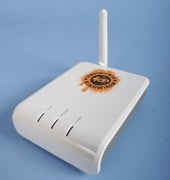 |
La Fonera, which measures just 3″ x 3.7″ and is less than an inch thick, features Atheros‘ single-chip 802.11b/g AR5006AP-G chipset, which is also found in routers from Netgear, D-Link and Belkin. The true cost of the router has not been released, but Mike Stauffer, director of business development at Atheros, says, “We are providing a low-cost solution because it’s a single chip.”
FON considers its subsidy of the unit for its users (called “Foneros”) to be part of the cost of acquiring new customers, just as mobile phone carriers subsidize the cost of new phones to attract new customers.
Joanna Rees, chairman of FON’s efforts in the United States, says, “We have been able to develop a router that we can [sell] at a reasonable cost for FON. Where other companies would say, ‘I’m going to spend $25—$30 to acquire a customer,’ our [cost] is through the router subsidy. We don’t want the router to be the sticking point to someone to share their Wi-Fi. We want to get the network in place.”
FON, which launched worldwide in February, claims 97,000 registered users so far, and has been backed by big name investors including Skype (eBay) and Google.
“They are investment partners,” says Rees. “They believe in what we’re building.”
What FON is building — or trying to build — is a global network of freely available Wi-Fi. Home users or small businesses purchase a La Fonera router — or in some cases, get them for free — and then agree to share their network 24 hours a day, seven days a week with other Foneros. FON customers who offer up free access to their own hotspots can then use any FON access point anywhere in the world for free. For those looking to charge for access, there is a revenue-sharing model they can subscribe to. Foneros who offer free access are called “Linuses,” after Linus Torvalds, inventor of Linux. Those who charge for access are called “Bills,” after Bill Gates. Non-Foneros, called Aliens, can also use the hotspots, but they always pay for the privilege.
“For consumers, the benefit is that if you share your Wi-Fi at home, you can do so securely, and you can roam the world for free,” says Rees.
Of course, if FON is encouraging users to give away unlimited Wi-Fi access for free, there is the question of how the company will generate enough revenue to stay afloat.
“Our business model comes in when a café or restaurant says, ‘I’ll share my Wi-Fi, but I don’t want to roam the world because I’m a café; I’d like to have a lower charge than another Wi-Fi hotspot,'” Rees says. “So we charge $2-$3 a day, and FON shares in the revenue. We share at a price lower than a T-Mobile connection, and the café gets a portion of that and we get a portion of that.”
FON is also focusing on forging relationships with other companies, including ISPs, who Rees says stand to benefit from FON’s network.
“There are a lot of content companies and product companies where ubiquitous Wi-Fi is important to their model,” says Rees. “And we have those relationships as part of our business model.”
“We are also working in cooperation with ISPs,” says Rees. “We will have several announcements coming out. There are two benefits. One is that the majority of people who sign up for cable get a router [and] don’t lock it down, so people leech off of other people’s Wi-Fi, which keeps others from getting their own broadband. If they plug in a FON router, they can’t leech, they have to be part of the program, so an ISP can monetize. It also encourages people — it’s a value proposition. If I have Wi-Fi at home, I can roam the world for free, so I’m going to get a broadband connection at home and become part of the benefit. We’re working on specific agreements.”
Rees emphasizes that FON is still early in its rollout.
“We’re early — we’re just starting our ramp,” says Rees. “The U.S. has been our largest market. We’ll start to see tremendous growth in our network in the next three months’ time. We are literally just kicking off.”
As part of its U.S. campaign, FON is targeting specific markets known for early adopters, including New York and San Francisco. Other cities that will likely see FON events come to town include LA, Seattle, Chicago, Atlanta and Dallas.
Adapted from wi-fiplanet.com.
| Do you have a comment or question about this article or other small business topics in general? Speak out in the SmallBusinessComputing.com Forums. Join the discussion today! |