







If site visitors aren’t being tracked, how can e-tailers figure out how to keep them? A 2003 survey from the e-tailing group finds that more than three-quarters of the respondents wisely implemented new technology in the last year, but critical back-end components are being neglected.
“Merchants are investing in the tools that help customers efficiently find what they want, enable smart browsing, timely and targeted communication and simplified ordering,” said Lauren Freedman, president of the e-tailing group, inc. “Unfortunately many of the sites now in need of platform upgrades or new servers launched with platforms that did not survive the recent technology demise. Others are kludged together with a mix of proprietary legacy systems and off-the-shelf software solutions. Either way these sites are forced to invest in improving their backbone before they can even consider other initiatives.”
As e-commerce has moved into the mainstream, e-tailers are faced with the challenge of updating and maintaining expensive IT investments — sometimes sacrificing measurement or marketing applications in the process.
The report found that 84 percent of the sites surveyed were using site activity and sales as the primary measurement tools, instead of a comprehensive data mining solution. Nearly half (43 percent) could not provide shopping cart abandonment figures and 14 percent could not identify customer conversion rates.
When the 200 senior executives that participated in the study were asked to rank their top technology initiatives for 2003, measurement was dead last. Platform servers and upgrades were the first priority, followed by order processing, performance, personalization, search, product enhancement, automation, channel integration, marketing, and finally, measurement.
While the priority list may indicate that marketing is a lesser concern, merchants are making some improvements to their e-mail communications with customers. Eight-in-ten of those surveyed said they use e-mail for store or product promotions, 70 percent highlight full-price products or seasonal messaging through e-mail, and 40 percent use e-mail as a branding vehicle. Opt-in and opt-out strategies are used in varying ways depending upon specific objectives: 37 percent elect to have customers opt-in, 19 percent prefer opt-out and 40 percent use a combination of both.
 When asked to rank certain site features relative to their business, merchants focused on cross-sells/up-sells (50 percent), personalization (50 percent), improved search (35 percent) and live customer service (25 percent).
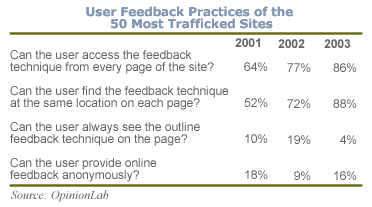
Customer service in the form of visitor feedback is the focus of a 2003 OpinionLab study of 50 heavily trafficked Web sites. This report, in its third consecutive year, found that 100 percent of the sites it evaluated had user feedback capability — up from 96 percent in 2002, and 98 percent in 2001.
Adapted from CyberAtlas.com