






Giant corporations aren’t the only companies with data storage needs that continue to increase at an alarming rate. Many small businesses face the same situation, which is compounded even more by regulatory compliance issues, small budgets and the lack of IT resources.
In an effort to address the need for more storage space, Buffalo Technologies, an Austin, Texas-based company, has just expanded the capacity of its TeraStation Terabyte network attached storage (NAS) device, the TeraStation Home Server. At the same time, Buffalo announced the availability of the new TeraStation Pro.
“We are in the age of the digital pack rat where you can’t get enough storage,” Morikazu Sano, senior vice president of global marketing said in a statement. “By giving home and business users access to the capacity, features and performance that the TeraStation offers at a price that fits into any budget, we are providing a cost-effective way to ensure their data is protected now and into the future.”
Both offerings are Windows and Mac compatible and can be configured in four operational modes that provide varying degrees of performance versus data redundancy. These including Standard Mode (where the capacity is divided into four equal segments), Spanning Mode (where the capacity is available as one large volume), Mirroring Mode (where the capacity is divided into two segments, one of which mirrors the data onto the other) and RAID 5 Mode (which combines both excellent performance and a measure of fault tolerance).

The NAS boxes also feature a 10/100/1000 Gigabit Ethernet port and what’s called Jumbo Frame capability (most Ethernet networks can transmit up to a 1,500 byte payload, whereas a Jumbo Frame usually means 9,000 bytes, but can refer to anything over 1,500). Basically it’s a fancy way of saying it can transmit data across the network really fast.
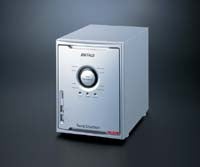
TeraStation Home Server
Previously available as a one-terabyte (T) product, the TeraStation Home Server will now be sold in one-terabyte and 2T configurations. The storage device includes four USB 2.0 ports, a built-in USB print server and a file server to facilitate printing and sharing files across a network.
The NAS box also includes software from Mediabolic that lets you share digital content with multiple PCs or entertainment equipment, such as stereos or televisions over the network, and Memeo AutoBackup backup software. The TeraStation Home Server will be available in May, with the 1.6T version selling for $1,499 and the 2T version selling for $1,899.

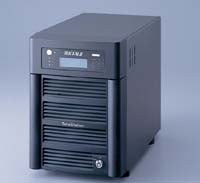
TeraStation Pro
Buffalo’s aiming the TeraStation Pro at the business sector, and it includes Active Directory member support — helpful for companies that use Windows 2000 or Windows Server 2003. It also includes four USB 2,0 ports, four SATA hard drives a lockable front-panel (for use when accessing or replacing drives) and Memeo AutoBackup backup software. The Pro also includes an LCD monitor that reports operational mode, disk usage, network information or operational problems.
Available now, the Pro sells for $1,999 and may be purchased from retail outlets, resellers and at Buffalo’s Web site.
Lauren Simonds is the managing editor of SmallBusinessComputing.com
| Do you have a comment or question about this article or other small business topics in general? Speak out in the SmallBusinessComputing.com Forums. Join the discussion today! |